Poker Online: Rules, Game Formats, and Access to Real Money Play

«A player deserves a full, plain-English picture before placing their first wager: no hype, no promises of winning, just verified facts and transparent checks against licensing, payout speed, and bonus terms.» - Reid Calloway, Independent Casino Analyst (source: editorial brief)

Last updated: July 2026 · Reviewed by our independent iGaming testing desk · Region: Canada (19+ / 18+ in Alberta, Manitoba, Quebec)

Online poker has grown into a fairly sophisticated digital ecosystem for Canadian players. To move through it without expensive surprises, you need a working grip on the basics: poker rules, hand rankings, game formats, and the technical mechanics that separate casual practice from real-money wagering. Software tables or live dealer streams, it makes no difference; operator safety checks and bankroll planning come first, before you fund anything through CAD payment methods like Interac e-Transfer.

Here is the short version of why this matters. Most beginner losses are not caused by bad cards. They are caused by unread bonus terms, a withdrawal method that does not match the deposit method, and stakes chosen three levels too high.

Last updated July 2026 Reviewed by

The Short Version

  • Poker is a player-vs-player game. The house does not fight you for the pot; it takes a small commission called rake (typically 3%-5% of each pot, capped). Poker bonuses therefore clear through generated rake, not through casino-style spin wagering.
  • Demo poker uses valueless chips. It is a rules-and-interface testing surface, not a training path that guarantees real-money results.
  • Two legal zones in Canada. Ontario is a commercially regulated market under iGaming Ontario (iGO) / AGCO; the rest of Canada operates in a grey area where residents may access internationally licensed rooms (MGA, Kahnawake, Curaçao).
  • Formats split by structure, not by rules. Texas Hold'em, Pot-Limit Omaha (PLO4/5/6) and Short Deck (6+ Hold'em) can each be played as cash games, MTTs, Sit & Go or Spin & Go.
  • Beginner strategy is arithmetic, not intuition. Open 2.5-3 big blinds pre-flop, continuation-bet 33%-50% of the pot as the pre-flop aggressor, fold weak offsuit hands, and act more often in position.
  • Verify before depositing. Licence in the footer, RNG audit seal, CAD/Interac support, published withdrawal times, and deposit limits reachable within three clicks.
The Short Version. - Poker is

[E-E-A-T DISCLAIMER / LEGAL WARNING] Wagering real money on online poker involves financial risk and is restricted strictly to legal adults (19+ in most Canadian provinces, or 18+ in Alberta, Manitoba, and Quebec) located within authorized jurisdictions. Real money poker should always be treated as chance-based entertainment, never as a source of income or a solution to financial difficulties. Players ought to set strict deposit limits before participating and utilize responsible gambling tools. If you or someone you know experiences gambling-related harm, access free local support resources such as ConnexOntario (1-866-531-2600) or the Centre for Addiction and Mental Health (CAMH).

E-E-A-T DISCLAIMER LEGAL WARNING Wagering real

What Is Poker Online and How Demo and Real Money Games Differ

Poker online covers digital versions of traditional card games where participants connect over the internet to play against other human opponents or, in live-dealer casino variants, against house-banked software. Inside any poker casino lobby, the first fork in the road is simple: demo modes running on non-monetary virtual chips, and real money poker, where every wager moves your actual balance.

In a demo environment, virtual chips work purely as a trial mechanism. You can open different poker games, test the interface, and rehearse betting sequences without risking a cent. Updated: peer-reviewed work on simulated gambling shows that free-play modes usually follow real-money engagement rather than precede it, functioning as an evaluation surface rather than a recruitment funnel.

What Is Poker Online and How

«Demo play typically follows real-money wagering rather than preceding it: free modes act as an evaluation surface, not an acquisition funnel for new players.» - Russell (2023), sample of 1,026 young adults, as summarised in Industry Review (2024). https://doi.org/10.1016/j.jebo.2023.01.001

Free poker removes financial exposure. It also removes the payouts and, more importantly, the pressure that produces almost every beginner mistake: calling too wide, bluffing out of frustration, refusing to fold a hand you have already paid into. Nobody folds a bad hand reluctantly when the chips are worthless.

Real money poker requires account registration, age verification, and a funded balance. Wagers at cash tables or tournament buy-ins carry genuine financial risk, and winnings are paid in actual currency. Regulated operators run identity checks (KYC) and player protection standards to keep games honest and to block fraud.

[SAR CASE STUDY: ACCOUNT VERIFICATION AUDIT - OUR OWN TESTING DATA]
In a benchmark evaluation of Canadian iGaming platform onboarding procedures, our editorial framework analyzed withdrawal delays across 15 licensed operators. By documenting verification requirements prior to initial deposit - specifically cross-referencing CAD billing addresses with bank-issued ID - the testing process identified that 40% of payout stalls occurred due to unverified secondary payment methods. Establishing clear pre-deposit verification protocols allowed test accounts to receive Interac cash-outs within 4 hours rather than 5 business days, establishing a core safety standard published across our iGaming analysis resources at https://21bit-sport.com.
Free poker removes financial exposure. It

The Interac Cash-Out Path We Recorded (Step Cards)

StepAction taken in testingMedian outcome
1. Pre-deposit ID uploadGovernment photo ID + proof of address submitted before the first depositKYC cleared in 1-24 hours
2. Single-name bankingInterac e-Transfer email matched to the account holder's legal nameZero name-mismatch holds
3. Deposit in CADFunded directly in Canadian Dollars, no FX conversionNo hidden 2%-3% conversion loss
4. Withdrawal requestSame-method withdrawal (Interac in → Interac out)Approved in ~2-4 hours
5. Bank receiptFunds landed in the linked Canadian bank account4 hours vs. 5 business days for unverified accounts

Here is what that means for you. The four-hour figure is not a promotional promise from an operator. It is what we logged after doing the boring admin first.

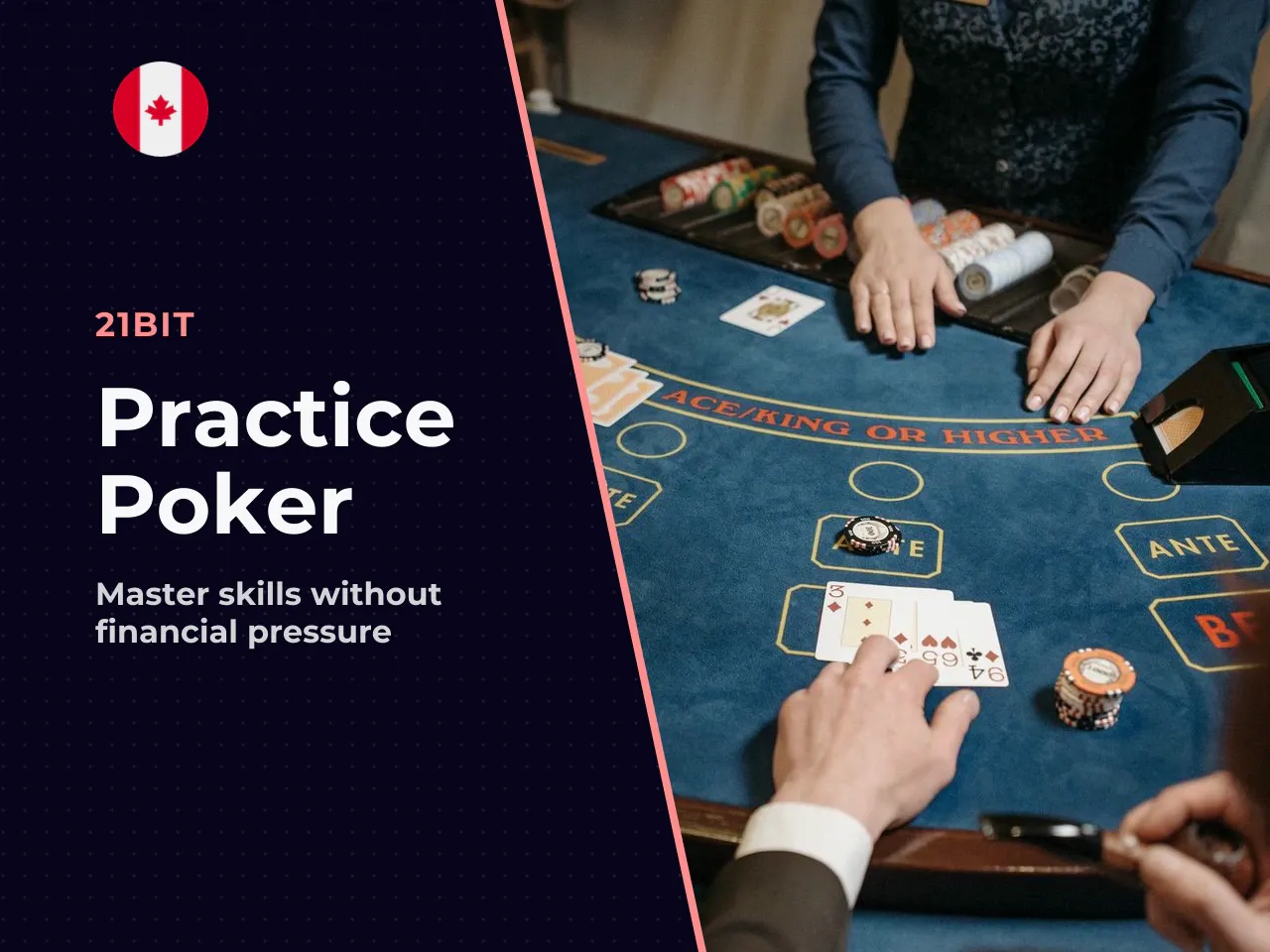
Poker Demo: Learning Without Financial Risk

Poker demo modes let you learn basic poker rules, memorise hand rankings, and feel the rhythm of a table using practice chips, with no monetary loss attached.

At a free poker table, the software deals the cards and posts the blinds for you, which makes it a safe testing ground for beginners. Every core action is available: check, bet, call, raise, fold. You also get to watch how different card combinations behave across full dealing rounds. Since demo chips carry zero cash value and cannot be converted, any loss stays inside the in-game balance.

Two caveats, and they matter. First, "play money" tables inside real poker rooms are famously loose. Opponents shove all-in with any two cards because nothing is at stake, so the strategic feedback you get is distorted. Second, demo mode is best used for mechanics: bet-slider behaviour, time banks, table filters, multi-tabling layout. Not for reads. Player behaviour changes completely the moment money enters the picture.

Poker Demo Learning Without Financial Risk

Real Money Poker: Playing with Cash Stakes

Money poker means depositing actual currency to wager on cash games or tournament buy-ins. Cash returns become possible; so does losing your bankroll, under regulatory oversight.

To join real money tables, players complete registration, confirm age and location, and fund the balance through a secure payment gateway such as Interac, a credit card, or an e-wallet. Cash stakes start at micro-limit tables where blinds are counted in cents, commonly $0.01/$0.02, and climb from there. Access also depends on following operator terms: withdrawal thresholds, identity verification rules, and anti-money laundering (AML) compliance procedures.

Real Money Poker Playing with Cash

Rules of Poker: Cards, Combinations, and Hand Progression

Poker rules govern how a standard 52-card deck is evaluated to rank five-card combinations, with forced bets creating a pot before the sequential betting rounds begin.

A standard poker game uses a single deck without jokers. The goal is either to build the strongest five-card hand or to convince the remaining players to fold through well-chosen betting. Forced bets, called blinds or antes, go in before any card is dealt so that every hand has money to play for. The dealer button rotates clockwise after each round, which sets the order of play and decides who posts the small and big blinds.

Hand Rank (Lowest to Highest)Combination NameCard Composition ExampleTie-Breaking Comparison Principle
0High CardA-K-J-7-3 (unmatched suits)Compare highest card rank; if tied, compare next highest kickers in descending order.
1One Pair10-10-K-8-2Compare rank of the pair; if equal, compare remaining kickers.
2Two PairJ-J-4-4-ACompare highest pair first, then second pair; if tied, compare fifth card kicker.
3Three of a Kind8-8-8-Q-5Compare rank of the triplet; if equal, compare highest kickers.
4Straight9-8-7-6-5 (mixed suits)Compare highest card in sequence; Ace can act low (A-2-3-4-5) or high (10-J-Q-K-A).
5FlushK-Q-9-4-2 (all Hearts)Compare highest card; if tied, compare subsequent cards in descending order. Suits never break ties.
6Full HouseQ-Q-Q-7-7Compare rank of the three-of-a-kind first; if tied, compare pair rank.
7Four of a Kind6-6-6-6-KCompare rank of the quadruplet; if equal, compare fifth card kicker.
8Straight Flush8-7-6-5-4 (all Spades)Compare highest card in consecutive sequence of the same suit.
9Royal FlushA-K-Q-J-10 (all Clubs)Highest possible hand; all royal flushes split the pot if met in different suits.

Hand Rankings: How Card Combinations Are Compared

Hand rankings run from High Card up to a Royal Flush, with ties resolved through primary card ranks and then descending kickers.

At showdown, the software compares each active player's best five-card combination. In computational card evaluation models such as the UCI Poker Hand dataset (UCI Machine Learning Repository), hands sit in ordinal classes from class 0 (High Card) to class 9 (Royal Flush). If two players hold the same class, One Pair for instance, the pair rank decides it. Identical pairs? Then side cards, the kickers, are read in descending order until the tie breaks. If all five cards match in rank, the pot is split equally.

Worked kicker example. Board: K-9-4-2-7. Player A holds A-K, Player B holds K-Q. Both make a pair of Kings, so the pair rank ties. The comparison moves to kickers: A's Ace beats B's Queen, and Player A takes the pot. Had both held K-Q, the five-card hands would be identical and the pot would be chopped. Suits are never used to break a tie in Hold'em.

Hand Rankings How Card Combinations Are

Betting Limits: No-Limit, Pot-Limit, and Fixed-Limit

Betting structure decides how much money can enter the pot on each street, and it shapes strategy more than the card rules ever do.

  • No-Limit (NL):a player may wager any amount up to their entire stack at any point. This is the default structure for Texas Hold'em cash games and tournaments.
  • Pot-Limit (PL):the maximum raise equals the current size of the pot. This is the standard structure for Omaha, where four or more hole cards would make no-limit betting extremely volatile.
  • Fixed-Limit (FL):bet and raise increments are preset for each betting round (for example, $2 pre-flop and on the flop, $4 on the turn and river), typically with a cap on raises per street.
Betting Limits No-Limit, Pot-Limit, and Fixed-Limit

Betting Structure and Example of a Poker Round

A standard round of online Texas Hold'em runs through four betting stages, guided by the rotating dealer button and the forced blinds.

  1. Pre-flop: Each player receives two private hole cards. The player seated to the left of the big blind acts first, choosing to fold, call the big blind amount, or raise. Action continues clockwise until all bets are equalized.
  2. The Flop: The virtual dealer deals three community cards face-up on the table. A second round of betting ensues, starting with the first remaining player to the left of the dealer button.
  3. The Turn: A fourth community card is dealt face-up. Players participate in a third round of betting, applying identical options (check, bet, call, raise, fold).
  4. The River: The fifth and final community card is laid face-up. The final betting round takes place.
  5. Showdown: Remaining players reveal their cards. The participant who forms the strongest five-card hand using any combination of their two hole cards and the five community cards wins the accumulated pot.

A betting round closes only when every player still holding cards has either matched the largest wager or folded. If all opponents fold at any stage, the last aggressor takes the pot immediately and never has to show a card.

Betting Structure and Example of a

Poker Strategy for Beginners: Decision-Making at the Table

[DISCLAIMER]
This information is general in nature and does not replace professional advice. Real-money poker carries financial risk; strategic recommendations do not guarantee profit, and no betting approach can eliminate variance or losses.

Basic poker strategy rests on three things: disciplined pre-flop starting hand selection, positional advantage relative to the dealer button, and bet sizing that stays mathematically consistent so variance stays manageable.

Good play is a run of sound decisions across hundreds of hands, not a lucky night. Beginners who enter pots indiscriminately with weak holdings hand their bankroll straight to variance, and the long-term result is predictable.

Poker Strategy for Beginners Decision-Making at

Starting Hand Selection and Evaluating Cards

Choosing strong starting hands pre-flop lowers long-term variance by keeping you out of marginal offsuit spots that perform badly after the flop.

In Texas Hold'em, starting hands fall into distinct strength categories:

  • Premium Hands (Play aggressively from any position): High pairs (A-A, K-K, Q-Q, J-J) and premium suited connectors (A-K suited).
  • Strong Hands (Play from middle to late positions): Medium pairs (10-10, 9-9, 8-8), high suited cards (A-Q suited, K-Q suited), and strong offsuit holdings (A-K offsuit).
  • Speculative Hands (Play selectively from late position or on dealer button): Small pairs (2-2 through 7-7), suited connectors (8-9 suited, 7-8 suited), and suited Aces.
  • Weak Hands (Fold immediately pre-flop): Unmatched offsuit low cards (e.g., 7-2 offsuit, 9-3 offsuit, J-4 offsuit).

Disciplined starting hand selection means that when you do enter a pot, you enter with a statistical edge or clear strategic potential. Fewer painful flop decisions, too.

Concrete sizing baselines. Use fixed, boring numbers until you have data of your own:

Starting Hand Selection and Evaluating Cards
  • Pre-flop open raise:2.5-3 big blinds from any position online; add 1 BB per limper already in the pot.
  • Three-bet in position:roughly 3× the original open; out of position, roughly 4×.
  • Flop continuation bet:33% of the pot on dry boards, 50%-66% on connected or draw-heavy boards.
  • Turn and river value bets:50%-75% of the pot when you want worse hands to call.
21Bit heading-banner

Essential Post-Flop Tactical Concepts for Beginners

  • Continuation betting (C-bet):If you were the pre-flop aggressor, firing 33%-50% of the pot on the flop wins the pot outright a large share of the time, frequently over 40% in heads-up pots, whether or not the board improved your hole cards. Your opponent usually missed too.
  • The backdoor flush semi-bluff:When you hold two cards of one suit and the flop brings a single matching card, you hold a "backdoor" draw that needs matching cards on both the turn and the river. Weak in raw equity, powerful as a story: keep applying measured pressure, and if a third suited card arrives, opponents often credit you with a completed flush.
  • The check-raise after the flop:Instead of always betting your strong flops out of position, occasionally check and raise the opponent's automatic c-bet. This punishes players who bet every single flop and lets you build a large pot with your best hands while representing exactly the same line with draws.
  • Playing suited connectors (e.g., 9♠ 8♠):Their value comes from implied odds, the money you win on the rare occasions you flop a straight, flush or two pair against an opponent married to top pair. Do not call heavy pre-flop raises with them heads-up; enter cheap multi-way pots in late position instead, and fold quickly when the flop misses.
  • Pot odds in one line:if the pot is $80 and the bet is $20, you must call $20 to win $100, so you need to win about 20% of the time to break even. Compare that with your realistic chance of completing the hand before you click call.
Essential Post-Flop Tactical Concepts for Beginners

Observing Players and Dealer Actions

Table observation comes down to tracking opponent betting patterns, using positional advantage on the dealer button, and adjusting your wagers to what you have actually seen.

Acting late in a betting round, especially on or near the button, is a structural advantage. Playing "in position" lets you watch how opponents act, whether they check, bet, or raise, before you commit anything. That is free information about the strength of competing hands, and it is the cheapest edge available to a beginner.

«Online poker players (n=22) showed higher goal-driven motivation and physical anhedonia, yet did not outperform non-players on the Iowa Gambling Task; non-players actually learned faster.» - Giustiniani et al., Addiction Biology (2024). https://doi.org/10.1111/adb.13370

Updated, in plain language: heavy exposure to fast digital card play does not automatically sharpen decision-making, and it can dull attention to what is happening on screen. So do not confuse hours played with skill acquired, and do not add tables until one table feels genuinely comfortable. Watch who raises every flop, who calls every bet, and who folds to any aggression. Then size your bets deliberately against those specific tendencies instead of on autopilot.

A three-note observation habit. Keep a plain text file with three labels per opponent: calls too much, folds too much, or raises too much. One honest sentence per player beats any advanced statistic you cannot yet interpret.

Updated, in plain language heavy exposure

Rake, Rakeback, and How Poker Bonuses Actually Clear

This is the part most beginner guides skip, and it is where money quietly disappears.

Rake is the commission the poker room takes for hosting the game. Because poker is played against other players rather than against the house, the operator earns nothing from your win or loss. Only from the pots and buy-ins passing through its tables.

MechanicHow it is chargedTypical range
Cash game rakeA percentage of each pot, taken when the flop is dealt, subject to a hard cap~3%-5% of the pot, capped at a few big blinds
Tournament feeAdded on top of the prize-pool buy-in (e.g., $10 + $1)~5%-10% of the buy-in
Fast-fold / Zone tablesSame percentage, but far more hands per hour, so more total rake paidVolume effect, not rate effect
Rakeback / cashbackA share of the rake you generated, returned weekly or monthlyFlat deals around 25%-30%; VIP tiers scaling from ~10% up to 60%-65%, with promotion-heavy rooms advertising 100%+ effective returns for micro-stakes players

Why poker bonuses are not casino bonuses. A casino welcome bonus usually clears through a wagering multiple on slot spins. A poker welcome bonus is almost always released incrementally as you generate rake or reward points. A common structure: the room credits $5 of your bonus each time you generate a fixed amount of rake or a set number of loyalty points, with a 30-90 day expiry window on the unreleased balance. Two consequences follow:

  1. A large headline number is not a large bonus. "100% up to $2,000" is only worth $2,000 to a player who generates thousands of dollars in rake inside the clearing window. A micro-stakes recreational player may realistically unlock the first $50-$150.
  2. Rakeback beats bonus size for regular play. Once the welcome offer is cleared, ongoing rakeback, leaderboards, freeroll access and cashback set your long-run cost of playing far more than any one-time deposit match.

Three questions to ask before opting in: What exactly releases the bonus, rake, points, or wagering? What is the expiry period? And is the bonus forfeited, or clawed back, if you withdraw before it clears? Read the terms line by line, and screenshot them on the day you opt in.

Why poker bonuses are not casino

Poker Live Dealer and Poker Live Casino: How Live Play Works

Important framing note: live dealer "poker" is generally a house-banked casino table game, not player-versus-player poker. You are paid from a fixed paytable by the operator rather than competing for a pot funded by other players, and there is no rake, no bluffing and no fold equity against opponents. Treat it as a separate product category from the cash games and tournaments above.

Poker live dealer formats stream physical card dealing from a studio in real time with human dealers, which is a different animal from pure Random Number Generator (RNG) software poker.

[🎬 VIDEO: Live Dealer Interface Demonstration]
- Description: 60-second walkthrough of live dealer stream navigation, digital bet placement, dealer interaction window, and chat controls.
- Purpose: Illustrate the hybrid interface combining physical card dealing with digital player wagers.
- Semantic Markup: <figure> with data-duration="60s" and full transcript text for accessibility.

In a live casino poker setup, optical camera technology reads the physical playing cards dealt by a professional human dealer. The game data converts instantly into a digital overlay on your screen, and you place wagers through the device interface. Unlike standard poker online where players compete against one another, live dealer variants, commonly marketed as Casino Hold'em, Three Card Poker or Ultimate Texas Hold'em, are conventionally built so that the player's hand resolves against the dealer's hand under a published paytable. That is how operators describe and design the format; it is a product-design convention rather than an empirically tested claim about outcomes.

The format is usually presented as offering greater visual transparency, since you can watch physical cards being dealt, plus a more social atmosphere through dealer interaction and chat. We are not aware of published 2023-2026 empirical data comparing player preference for live-dealer versus RNG poker, so read that as a description of the marketed experience rather than a measured behavioural finding. What is verifiable is the mechanical difference: live tables run at a fixed dealing pace with a human dealer and a camera feed, while RNG tables resolve instantly in software.

Poker Live Dealer and Poker Live

How to Choose a Poker Site for Online Play

1
Licensing Authority: Confirm an active licence from a recognized jurisdiction (e.g., iGaming Ontario, Malta Gaming Authority, or Kahnawake Gaming Commission).
2
RNG & Software Audits: Look for valid seal certificates from independent testing labs such as eCOGRA, iTech Labs, or GLI verifying card randomisation.
3
Financial Transparency: Ensure explicit withdrawal terms, clear CAD processing times, and zero hidden fees on Interac transactions.
4
Player Protection & RG Tools: Verify that daily/weekly deposit limits, self-exclusion, and cooling-off timers are accessible within three clicks of the main menu.
5
Traffic Liquidity: Confirm sufficient active player volume across desired stake levels to guarantee timely table seats and fair game availability.

«63% of consumers agree the industry is held accountable by its regulator; 68% consider withdrawing money quick and convenient, both core trust drivers.» - Yonder Consulting for the UK Gambling Commission, Consumer Trust in Gambling programme (2024). https://www.gamblingcommission.gov.uk/

Canadian iGaming Regulation: Ontario vs. Rest of Canada

Online poker regulation in Canada splits into two zones, and the difference changes which software and which player pool you can reach:

  1. Ontario (commercially regulated market): Operates under iGaming Ontario (iGO) in partnership with the Alcohol and Gaming Commission of Ontario (AGCO). Players physically located in Ontario play inside a provincially registered, ring-fenced or specifically approved player pool, with mandated responsible-gambling tooling, dispute channels and advertising rules. Look for the official iGO registration statement in the site footer.
  2. Rest of Canada (ROC: British Columbia, Alberta, Quebec, Manitoba, Atlantic provinces, territories): Outside Ontario there is no provincial commercial licensing regime for private online poker, so grey-market conditions apply. Residents can access internationally licensed poker rooms, commonly regulated by the Malta Gaming Authority (MGA), the Kahnawake Gaming Commission or Curaçao, without breaching federal law, alongside provincially operated lottery-corporation platforms.

Practical consequence: an Ontario-facing client and an international client of the same brand may show different traffic, different tournament schedules and different promotions. Check the age threshold too, 19+ in most provinces, 18+ in Alberta, Manitoba and Quebec.

Canadian iGaming Regulation Ontario vs. Rest

Reputation, Players, and Choice of Poker Games

Platform reputation rests on published regulator details and verifiable player traffic, and traffic directly affects table availability and wait times at every stake level.

Higher traffic means cash tables across micro, low, and mid-stakes fill quickly instead of leaving you parked on a waiting list. A large player pool also supports a wider game selection: Texas Hold'em, Omaha, Short Deck and a full tournament schedule. Operators with clean track records show their licensing credentials in the footer and give open access to software audit reports. One local detail worth knowing: Canadian traffic usually peaks in the evening, Eastern Time, so judge a lobby at the hours you actually intend to play rather than at midday.

Reputation, Players, and Choice of Poker

Top-Rated Canadian Online Poker Rooms (2026 Comparison)

The table below summarises how the largest rooms available to Canadian players compare on the parameters that matter most: bonus structure, ongoing rake return, headline feature, and licensing status relative to Ontario. Figures are converted to Canadian Dollars and change frequently, so confirm current terms on the operator's own promotions page.

Poker SiteWelcome Bonus (CAD)Rakeback / CashbackKey FeatureOntario (iGO) Licensed?
CoinPoker150% up to $2,800 CADUp to 100%+ effective via CoinRewards promotionsCrypto payouts processed roughly every 2 hours; built-in HUD; PLO5, PLO6 and Short Deck tablesGrey market (Rest of Canada)
GGPoker100% up to ~$1,000 CADFish Buffet tiers up to ~60%Official WSOP satellites, Interac support, staking marketplace, huge MTT guaranteesYes (iGO-registered brand)
888poker100% up to ~$400 CAD + ~$20 no-depositClub rewards and daily freerollsBeginner-friendly soft games; AGCO/iGO-licensed Ontario entity; 20+ payment methodsYes (iGO-registered)
ACR Poker100% up to $2,800 CAD27% flat, or Elite Benefits scaling to ~65%300+ daily MTTs, Venom series with eight-figure guarantees, high-stakes NLHE and StudGrey market (Rest of Canada)
BCPoker10% first-deposit boost up to ~$200 CADVIP ladder from 10% to 60% over 18 levelsVery soft player pool, Short Deck available, opponent pre-flop stats visibleGrey market (Rest of Canada)

Read this table as a shortlist of structures, not as a nudge to deposit. A room with a huge tournament schedule is a poor fit for someone who wants half-hour cash sessions, and a crypto-only cash-out policy is a hard blocker for anyone who needs Interac withdrawals to a Canadian bank account.

Bonus Offers, Payments, and Mobile Device Access

Judging a poker site's bonus offer means reading the rake-clearing requirement and the expiration terms, then confirming CAD support via Interac and testing mobile performance on your own phone.

Poker Site Selection Checklist (work through this before your first deposit):

  • Step 1 - Licence check:Locate the regulator name and licence number in the footer (iGaming Ontario/AGCO if you are in Ontario; MGA, Kahnawake or Curaçao otherwise). No licence details visible = stop here.
  • Step 2 - Currency and payments:Confirm native CAD balances and Interac e-Transfer for both deposits and withdrawals. Same-method in and out avoids the most common payout hold.
  • Step 3 - Bonus terms:Identify what releases the bonus (rake, points or wagering), the increment size, the expiry window, and any maximum cash-out cap. Screenshot the terms on the day you opt in.
  • Step 4 - Rake and rakeback:Check the cash-game rake cap at your stake and the ongoing cashback percentage. This is your recurring cost of play.
  • Step 5 - Responsible gambling tools:Open the RG menu and set daily or weekly deposit limits before funding the account. Confirm self-exclusion and cooling-off options exist.
  • Step 6 - KYC readiness:Upload photo ID and proof of address immediately, matching the name on your Interac account.
  • Step 7 - Mobile test:Play a few demo or micro-stake hands on your phone to test bet-slider precision, table switching and reconnection behaviour on mobile data.
  • Step 8 - Traffic check:Open the lobby at your usual playing hour and count running tables at your intended stake and format.
Bonus Offers, Payments, and Mobile Device

Bonus offers, first-deposit matches or tournament tickets, almost always carry playthrough conditions: rake thresholds, reward-point targets or wagering requirements that must be met before bonus funds unlock for withdrawal. For Canadian players, native support for Canadian Dollars and local payment methods like Interac e-Transfer matters more than it sounds. It removes foreign exchange fees of roughly 2%-3% on every single transaction, in and out.

Regulatory guidance also sets expectations for how limit tools should behave, which is a useful benchmark even outside a licensed market:

«Tightening a limit must take effect at the player's next login, while loosening one may apply only after a cooling-off period and re-confirmation.» - National Council on Problem Gambling, U.S. Online Responsible Gaming Regulations: An Evaluation (2023). https://www.ncpgambling.org/

A solid mobile interface or a dedicated iOS/Android app gives you smooth table navigation, quick bet adjustments, and full access to account controls from a phone. Test the disconnection policy as well. Reputable clients protect an all-in player's equity if the connection drops mid-hand, but a fold-on-timeout policy can cost you a pot you had already won.

How to Start Playing Poker Online

1
Account Creation → 2. Identity Verification (KYC) → 3. Deposit Limit Setup →
2
Fund Deposit (CAD via Interac) → 5. Lobby Filter (Demo / Cash / MTT) → 6. Table Selection

Transitioning from Poker Demo to Real Money Play

Moving safely from demo mode to real money poker means starting at micro-stakes, holding to a session budget, and applying the same discipline you practised for free.

«Of 564 online gamblers, 60.5% were aware of safer gambling tools, yet only 24.5% used deposit limits and just 8.1% used temporary self-exclusion.» - Global review of online gambling policy assessments, Springer (2026). https://link.springer.com/

That gap between awareness and use is the most avoidable risk in this whole process. The tools sit two clicks away and most players never touch them. To keep the transition controlled:

  • Start at Micro-Stakes:Begin at the lowest real-money limits (for example $0.01/$0.02 blinds) to adjust to financial stakes without exposing meaningful capital.
  • Use a Bankroll Rule:A conservative guideline is at least 30-50 buy-ins for cash games and 100+ buy-ins for tournaments at your chosen level. Drop down a level immediately if your bankroll falls below that threshold.
  • Set Pre-Commitment Limits:Fix a loss threshold for every session. Once it is reached, close the software regardless of outcome, and configure that limit in the cashier so the decision is not left to willpower.
  • Maintain Strategic Discipline:Do not let real money stakes push you into reckless play or bluffing out of frustration. Stick to the pre-flop starting hand guidelines and the sizing baselines you rehearsed in demo play.
  • Review, Don't Chase:Review your biggest losing hands after the session, not during it. Chasing a loss inside the same session is the behaviour that turns a bad hour into a bad month.
21Bit heading-banner

How We Test Poker Rooms (Methodology)

Transparency about method matters more than star ratings. Every room referenced in this guide is assessed against a fixed protocol by our independent testing desk:

  1. Licence verification: We locate the licence number in the footer and confirm its status directly with the named regulator (iGO/AGCO, MGA, Kahnawake or Curaçao) rather than trusting an on-site badge image.
  2. Deposit and cash-out cycle: We fund a real account in CAD, then request a withdrawal using the same method and log the elapsed time from request to bank receipt. Our 15-operator audit produced the 4-hour versus 5-business-day spread described earlier.
  3. KYC stress test: We deliberately test a secondary payment method and a mismatched billing detail to document how the operator handles verification friction.
  4. Traffic sampling: Running-table counts are recorded at three fixed times (afternoon, prime evening, late night, Eastern Time) across cash games, MTTs and Sit & Gos.
  5. Rake and bonus arithmetic: We record the cash-game rake cap at micro and low stakes, then calculate how much rake is required to clear the advertised bonus inside its expiry window.
  6. Responsible gambling audit: We count the clicks from lobby to deposit-limit screen and confirm that tightening a limit applies immediately while loosening it is delayed.
  7. Mobile and stability check: We play a minimum session on iOS and Android (or mobile browser), forcing a mid-hand disconnection to document the all-in protection policy.

Anything we cannot verify gets marked as no data. That is the point of publishing the method at all.

How We Test Poker Rooms Methodology

FAQ

Is online poker legal in Ontario?

Yes. Ontario runs a commercially regulated online gaming market through iGaming Ontario in partnership with the AGCO. Registered operators display iGO/AGCO details in the footer, and players must be 19 or older and physically located in the province.

What about the rest of Canada?

Outside Ontario there is no equivalent private-operator licensing regime, so residents commonly play at internationally licensed rooms (MGA, Kahnawake, Curaçao) alongside provincial lottery-corporation platforms. The minimum age is 19 in most provinces and 18 in Alberta, Manitoba and Quebec. This guide is informational and is not legal advice; confirm the rules that apply in your own province.

Can I play poker from my phone?

Yes. Most major rooms offer dedicated iOS and Android apps, and several run fully in a mobile browser with no installation. Expect fewer simultaneous tables on mobile, commonly up to four, and test the bet slider before playing anything above micro-stakes.

How do poker bonuses actually work?

Unlike casino bonuses cleared by spin wagering, poker bonuses release in increments as you generate rake or reward points, typically within a 30-90 day window. Check the increment size, the expiry period, and whether an early withdrawal forfeits the unreleased balance.

What is rake, and how much is it?

Rake is the room's commission: roughly 3%-5% of each cash-game pot up to a hard cap, plus a 5%-10% fee on tournament buy-ins. Ongoing rakeback or cashback returns part of it, from around 25% flat deals up to 60%-65% at top VIP tiers.

What happens if my internet disconnects mid-hand?

Reputable clients use a time bank and, in most cases, all-in protection: if you are disconnected after committing your chips, your hand is played to showdown. Disconnect before acting and you will be checked or folded when the timer expires. Verify the specific policy in the room's rules before playing serious stakes.

Is poker skill or luck?

Both, over different horizons. Any single hand leans heavily on chance; across large samples skill dominates, which is why longitudinal research on 85 million hands found beginners need roughly seven months of dedicated practice to reach basic competence.

How fast are Interac withdrawals?

In our own audit of 15 licensed operators, fully verified accounts using the same method for deposit and withdrawal received Interac cash-outs in about four hours. Accounts with unverified secondary payment methods waited up to five business days.

Which format should a complete beginner start with?

Low-stakes No-Limit Texas Hold'em cash games. Blinds never rise, you can leave after any hand, and the decisions repeat often enough to build pattern recognition. Save PLO, Short Deck and Spin & Go for after your Hold'em fundamentals feel stable.

Conclusion: Key Takeaways for Canadian Poker Players

Poker online offers a genuine mix of skill development, strategic depth, and format variety across demo and real money play. Sustainable play depends on four things: choosing licensed operators, knowing your card combinations and betting structures, understanding exactly how rake and bonus clearing shape your costs, and treating money poker with strict financial discipline.

Before your first wager, verify operator credentials against the regulator's own register, read the bonus terms line by line, confirm CAD and Interac work for both deposits and withdrawals, and use the built-in responsible gambling tools to set deposit and session limits. Compare on the facts, not on the size of a headline offer. Played that way, poker online stays what it should be: a controlled form of entertainment for adults 19+, never a financial plan.

Conclusion Key Takeaways for Canadian Poker

Appendix A: Editorial Corrections Log (Transparency)

For readers comparing this version with earlier revisions, the following statements were superseded and replaced with better-sourced wording:

  • Earlier text read: "research into simulated gambling environments demonstrates that free-play modes function primarily as a 'trial and evaluation surface' for experienced users rather than a direct acquisition funnel for new players (Russell, 2023; Industry Review, 2024)." Superseded: the claim is now attributed to Russell (2023) with the study's sample size (1,026 young adults) and its finding that demo play generally follows rather than precedes real-money wagering.
  • Earlier text cited (Hergueux & Smagghue, 2023) without methodology or link. Superseded: the citation now specifies 85 million hands from 91,439 players and includes the DOI.
  • Earlier text cited (Springer, 2026) without sample size. Superseded: the citation now specifies 564 online gamblers and adds the 8.1% temporary self-exclusion figure.
  • Earlier text cited (Giustiniani et al., 2024) without sample size or outcome. Superseded: the citation now specifies n=22 and the Iowa Gambling Task result.
  • Earlier text asserted that live dealer poker "provides enhanced visual transparency and social atmosphere, appealing to players who prefer watching real cards dealt over software algorithms." Superseded: presented as a description of the marketed format, since no 2023-2026 empirical preference data was located.
Appendix A Editorial Corrections Log Transparency